SCPP: Soft Clustering Python Package - Documentation
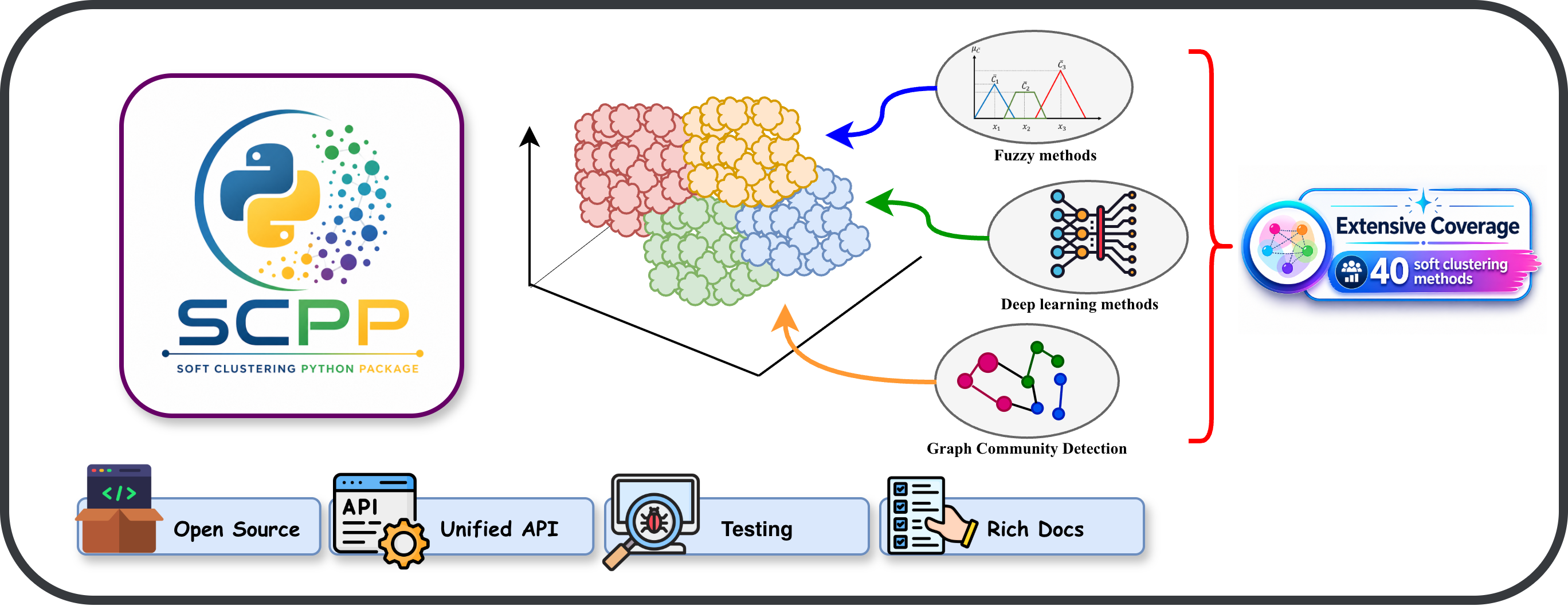
SCPP collects 42 soft clustering algorithms behind one estimator protocol, spanning fuzzy, possibilistic, evidential, probabilistic, graph, document, ensemble and deep methods, together with a benchmarking suite for comparing them on equal terms.
This package is designed to support research and applied workflows involving clustering under uncertainty, overlapping memberships, and soft assignments.
Highlights
One protocol, 42 algorithms — Every estimator exposes
memberships_,labels_,centers_andn_clustersafterfit, regardless of whether the method consumes a feature matrix, a graph, raw documents, or an ensemble of partitions.Checked, not asserted — A conformance suite fits all 42 estimators on every commit and verifies the contract: membership shape, the partition constraint where the formulation imposes one, out-of-sample behaviour,
sklearn.cloneround-tripping, and reproducibility under a fixedrandom_state.Benchmarking included — Runtime, memory, scalability and clustering quality, over 20 datasets and 12 validity metrics — shipped inside the package.
Light by default — A base install requires only
numpy,scipy,scikit-learnandtypeguard— enough to fit 38 of the 42 estimators. PyTorch and pandas live behind extras you opt into.Typed — Ships
py.typed; hints are checked at runtime bytypeguardand visible to your type checker.
Installation
The package can be installed from PyPI:
pip install soft-clustering
Optional extras, separated by what they are needed for:
Extra |
Install |
Needed for |
|---|---|---|
(base) |
|
Fitting any of the 38 non-deep estimators |
|
|
CDCGS, DMoN, NOCD, RDFKC |
|
|
Running |
|
|
Agreement checks against third-party implementations |
|
|
Building the documentation |
|
|
Developing and testing |
Requires Python 3.10 or newer.
Quick Start
Basic usage with the package API:
import numpy as np
from soft_clustering import FCM

rng = np.random.default_rng(0)
X = np.vstack([rng.normal([0, 0], 0.4, (100, 2)),
               rng.normal([4, 4], 0.4, (100, 2))])

model = FCM(n_clusters=2, random_state=0).fit(X)

model.memberships_    # (200, 2) degrees of membership, rows sum to 1
model.labels_         # (200,)   arg-max hard assignment
model.centers_        # (2, 2)   cluster prototypes
model.n_clusters      # 2        the partition actually produced
Every estimator follows the same shape, so swapping the method is a one-word change:
from soft_clustering import ECM, GK, PCM, RoughKMeans

for cls in (GK, PCM, ECM, RoughKMeans):
    model = cls(n_clusters=2).fit(X)
    print(f"{cls.__name__:20s} {model.memberships_.shape}")
Algorithm Catalogue
Grouped by what the algorithm consumes. ⚡ marks estimators requiring the deep extra.
Feature matrix — 26 estimators
Estimator |
Full Name |
Description |
|---|---|---|
Fuzzy C-Means |
The canonical membership-based method |
|
Possibilistic C-Means |
Typicalities; rows need not sum to 1 |
|
Possibilistic Fuzzy C-Means |
Combines memberships and typicalities |
|
Gustafson–Kessel |
Adaptive per-cluster covariance |
|
Evidential C-Means |
Belief masses over sets of clusters |
|
Kernelized Fuzzy C-Means |
Kernel-space distances |
|
Spatially-Constrained Kernelized FCM |
Adds an image neighbourhood term |
|
Kernel-based Fuzzy Competitive Learning |
Competitive-learning update |
|
Collaborative Annealing FCM |
Deterministic annealing |
|
Centroid Auto-Fused Hierarchical FCM |
Fuses centroids hierarchically |
|
Entropy c-Means |
Entropy regularisation in place of the fuzzifier |
|
AFCM with full graph embedding |
Graph-regularised memberships |
|
AFCM without graph embedding |
The unregularised variant |
|
Adaptive FCM for image segmentation |
Operates on a single image |
|
Fuzzy Color Clustering |
Fuzzy colour spheres in CIELAB space |
|
Robust Projected Fuzzy K-Means |
Joint dimensionality reduction for noisy, high-dimensional data |
|
Semi-supervised Fuzzy Clustering with Membership Prior |
Consumes a partially labelled target vector |
|
Federated Multiple Imputation Fuzzy Clustering |
Consumes per-client matrices |
|
Rough K-Means |
Lower and upper approximations |
|
Subtractive Clustering Method |
Determines the cluster count itself |
|
Soft DBSCAN with Gaussian mixtures |
Density-based, discovers k |
|
Soft Kernel Spectral Clustering |
Semi-supervised; two non-parallel hyperplanes |
|
Gaussian Mixture (EM) |
Responsibilities as memberships |
|
Beta-Gaussian Mixture Model |
Two aligned views |
|
Multivariate Beta Mixture Model |
For data on the unit interval |
|
RDFKC ⚡ |
Robust Deep Fuzzy K-Means |
Image tensors |
Graphs and networks — 6 estimators
Estimator |
Full Name |
Description |
|---|---|---|
Cluster Affiliation Model for Big Networks |
Overlapping communities at scale |
|
Bayesian NMF for overlapping communities |
Automatic relevance determination |
|
MMSB ⚡ |
Mixed Membership Stochastic Blockmodel |
Generative blockmodel |
NOCD ⚡ |
Neural Overlapping Community Detection |
GNN + Bernoulli–Poisson |
DMoN ⚡ |
Deep Modularity Networks |
Modularity-optimising pooling |
CDCGS ⚡ |
Community Detection via Gumbel Softmax |
Differentiable assignment |
Documents and text — 5 estimators
Estimator |
Full Name |
Description |
|---|---|---|
Latent Dirichlet Allocation |
Topic–word and document–topic factors |
|
Probabilistic Latent Semantic Indexing |
Likelihood-based topic model |
|
Similarity-Based Soft Clustering |
Discovers the cluster count |
|
Modified Fuzzy ART for documents |
Adaptive resonance |
|
Word-Based Soft Clustering |
Word-driven soft assignment |
Ensembles and consensus — 3 estimators
Estimator |
Full Name |
Description |
|---|---|---|
Soft CSPA |
Similarity-based consensus over soft partitions |
|
Soft HBGF |
Bipartite graph consensus over concatenated memberships |
|
Soft MCLA |
Groups clusters into meta-clusters |
Benchmarking
The benchmarking suite ships inside the package, so it is available straight after installation.
pip install "soft-clustering[bench]"
from soft_clustering import FCM, GK, PCM
from soft_clustering.benchmarking import (
    ClusteringBenchmark,
    ClusteringQualityBenchmark,
    RuntimeBenchmark,
    get_dataset,
)

X, y = get_dataset("iris")

results = ClusteringBenchmark(
    models=[
        FCM(n_clusters=3, random_state=0),
        GK(n_clusters=3, random_state=0),
        PCM(n_clusters=3, random_state=0),
    ],
    benchmarks=[RuntimeBenchmark(n_repeats=3), ClusteringQualityBenchmark()],
).run(X, y)
Included backends:
⏱️
RuntimeBenchmark— Fit and predict time, with repeats and standard deviation💾
MemoryBenchmark— Resident set size sampled during the fit📈
ScalabilityBenchmark— Runtime and memory as the sample count grows🎯
ClusteringQualityBenchmark— Silhouette, Calinski–Harabasz, Davies–Bouldin; ARI and NMI when labels are given; partition coefficient and entropy
Also included: 20 datasets (bundled, synthetic and OpenML) and 12 validity metrics.
See Benchmarking for the full reference.
Testing
The project includes a comprehensive test suite in the tests/ directory, covering all implemented algorithms.
To run the tests:
pip install -e ".[dev,deep]"
pytest
See tests/HOW_TO_RUN.txt for more details.
Development
git clone https://github.com/soft-clustering/soft-clustering.git
cd soft-clustering
pip install -e ".[dev,deep]"

pytest                                                    # tests
pytest --cov=soft_clustering --cov-report=term-missing    # with coverage
ruff check soft_clustering tests example tools            # lint
black --check soft_clustering tests example tools         # formatting
sphinx-build -b html -W docs/source docs/_build/html      # docs, warnings are errors
See CONTRIBUTING.md for the estimator protocol and what adding an algorithm involves.
Citation
This package accompanies a paper submitted to the JMLR MLOSS track.
Paper: arXiv:2607.19620
@misc{rezaee2026scppunifiedpythonlibrary,
   title={SCPP: A Unified Python Library for Soft Clustering},
   author={Kiyan Rezaee and Morteza Ziabakhsh and Artin Bahrampour and
           Seyed Mohammad Ghoreishi and Asal Khaje and Ali Sajedifar and
           Manny Chalak and Ava Zerafatangiz and Sadegh Eskandari},
   year={2026},
   eprint={2607.19620},
   archivePrefix={arXiv},
   primaryClass={cs.LG},
   url={https://arxiv.org/abs/2607.19620},
}
Contributing
Contributions, bug reports and algorithm proposals are all welcome.
Security policy — please report vulnerabilities privately
License
Distributed under the terms of the MIT license.
API Reference
- SCPP: Soft Clustering Python Package - Documentation
- Benchmarking
- Algorithms
- AFCM (Full Graph Embedding) Documentation
- AFCM (Without Graph Embedding) Documentation
- AFCMAdaptive (Adaptive Fuzzy C-Means for Image Segmentation) Documentation
- BGMM (Beta-Gaussian Mixture Model) Documentation
- BIGCLAM (Cluster Affiliation Model for Big Networks) Documentation
- Bayesian NMF for Overlapping Community Detection
- CAFCM (Collaborative Annealing FCM) Documentation
- CAF-HFCM (Centroid Auto-Fused Hierarchical FCM) Documentation
- CDCGS (Community Detection Clustering via Gumbel Softmax) Documentation
- DMoN (Deep Modularity Networks) Documentation
- ECM (Evidential C-Means) Documentation
- EVCLUS (Evidential Clustering of Proximity Data)
- FCC (Fuzzy Color Clustering) Documentation
- Fuzzy C-Means (FCM)
- FeMIFuzzy (Federated Multiple Imputation Fuzzy Clustering) Documentation
- GathGeva (Gath–Geva / Fuzzy Maximum-Likelihood Estimation)
- Gustafson–Kessel (GK)
- Gaussian Mixture Models (GMM)
- Kernel-based Fuzzy Competitive Learning (K-FCCL)
- Kernelized Fuzzy C-Means (KFCM)
- A Modified Fuzzy ART for Soft Document Clustering (KMART)
- Latent Dirichlet Allocation (LDA)
- MBMM (Multivariate Beta Mixture Model) Documentation
- MMSB (Mixed Membership Stochastic Blockmodel) Documentation
- Neural Overlapping Community Detection (NOCD)
- Possibilistic C-Means (PCM)
- Possibilistic Fuzzy C-Means (PFCM)
- Probabilistic Latent Semantic Indexing (PLSI)
- Robust deep fuzzy 𝐾-means clustering for image data (RD-FKC)
- Rough K-Means (RoughKMeans)
- RPFKM Algorithm Documentation
- Subtractive Clustering Method (SCM)
- SCSPA Algorithm Documentation
- SFCMEP (Semi-supervised Fuzzy Clustering with Membership Prior)
- SHBGF Algorithm Documentation
- Similarity-Based Soft Clustering (SISC)
- SKFCM (Spatially-Constrained Kernelized Fuzzy C-Means) Documentation
- SMCLA Algorithm Documentation
- Soft DBSCAN-GM Documentation
- SoftKSC (Soft Kernel Spectral Clustering) Documentation
- Word-Based Soft Clustering (WBSC)
- EntropyFCM (Entropy c-Means) Documentation